
Why samples are indispensable for design practices
Before we dig deep into the box of tips and tricks for good sample presentations, let’s take a look at why samples are so important for architects and interior architects, and therefore directly for clients and developers too:
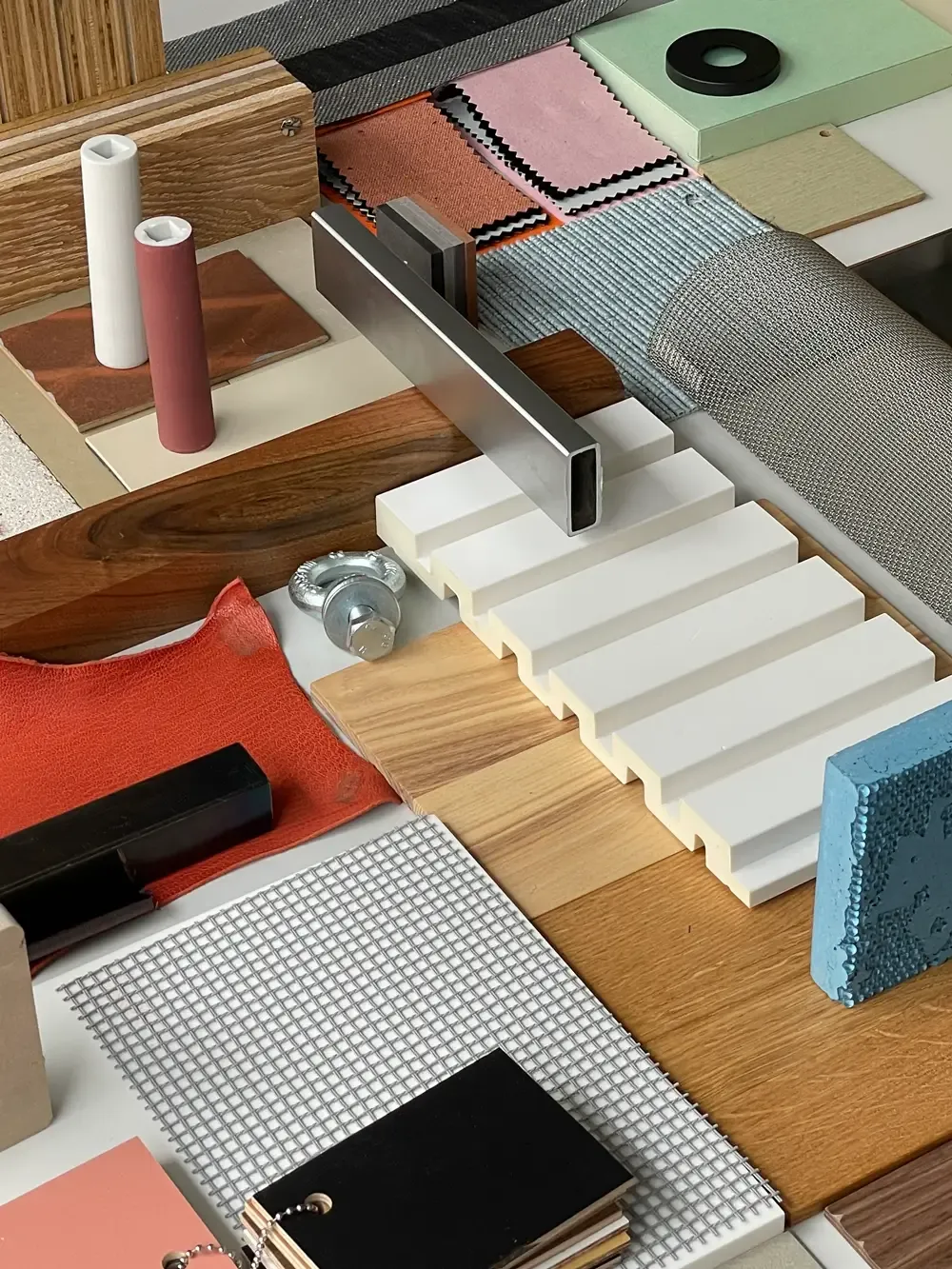
Samples…
…inspire
They help to make vague visions concrete and quickly turn a first idea into a (quite literally) tangible design.
…don’t lie
Only by physically touching a material can you really judge whether it meets the functional and aesthetic requirements, whether in terms of feel, scratch resistance, toughness or colour accuracy.
…speed up decisions
In discussions with the client, samples are an indispensable means of communication for illustrating surfaces and making the final selection.
»One thing you should bear in mind: as soon as the sample touches the hand of an architect or interior architect, their attention is gone, at least for a brief moment. It is felt and examined from every side: a blessing and a curse at the same time, so to speak. So think carefully about when you hand over the sample, and place your most important information before or after.«
Franziska HolzmannStrategic Consultant at hej.build
The sample’s journey: how to stand out at every stage
From the request to the practice (and ideally, by the way, back to the manufacturer again), a sample passes through numerous stages. At each of these stages there is a chance to stand out from the competition, whether through the sample itself or through the service that goes with it. But when and how can you influence what?
1. Request and sample order: a good user experience from the start
How easy do you make it for design practices to order products and samples to their office? A process that is intuitive and simple is recommended. Order forms on the website or fixed contacts at the company who can be reached without fuss are ideal. Avoid complex request forms or missing contact details on the website. Samples that cost money? A clear deterrent.
2. Packaging and presentation: first impressions count
Deliver your samples in well-thought-out, practical packaging. Provide sample folders, boxes or bags that are easy to handle and look good. Removable samples that can be put together individually for different sampling situations score particularly well. Be sure to avoid unnecessarily large outer packaging that ends up containing just one small sample. That seems not only impractical but also hardly sustainable.
3. Labelling and product information: no room for mix-ups
A sample that passes through many hands must be recognisable at all times. The manufacturer’s name, product details and QR codes that lead directly to the specific product page, not to the manufacturer’s homepage, are an absolute must. No labelling on the products at all? Then samples often never find their way back from desks or project boxes into the right packaging.
4. Logistics and delivery: delays don’t belong here
One of the scarcest resources in design practices is time. So make sure your delivery service is fast and reliable. A damaged or late sample can disrupt the whole design process, and if in doubt, the practice will turn to a faster competitor. Offer to take back large samples or samples that are no longer needed, because besides time, space in the office is often short too. A quick, straightforward collection service is a plus.
5. Arrival at the design practice: spotlight or layer of dust?
Your sample has to hold its own. Most design practices are short of space, and lots of materials are waiting to be managed. Format is the decisive point: for your sample to be well received, it should be handy, easy to store and well organised. Formats or bindings that can be used flexibly and put together individually are particularly popular. Also offer your samples in different formats or with the help of overview cards.
Talk to us
Would you like to check whether your sample presentation suits your target group and is up to date? Let’s take a look at it together. Feel free to contact us via our contact form.
Samples, oh samples: challenges for design practices and manufacturers
Samples are essential for design practices. But practices often face the challenge of managing their growing sample collections and avoiding unnecessary sprawl: different formats, lack of space and the time spent on upkeep eat up valuable resources. For architects, compact, current, labelled and quickly accessible samples are therefore a must. Their clear request to manufacturers? Make it as easy and straightforward for them as possible.
Manufacturers, on the other hand, often struggle to develop a sample presentation that not only looks convincing and matches the visual habits of aesthetes, but is also practical and cost-efficient. Because costs are hidden in both production and packaging, which is why the quality of the product samples and attractive, economical packaging sometimes fall short. Success also depends heavily on reliable delivery and well-planned logistics.
But a small tip on the side: the effort is worth it. Because anyone interested in your samples is usually also interested in your company. And is therefore a hotter lead than fleeting trade fair visitors.
»We want to be fed with what’s happening at manufacturers in terms of innovation.«
Anni Rosenbergbrandherm+krumrey interior architecture

For our Industry Update on sample presentation, we asked Anni Rosenberg, interior architect and associate at brandherm + krumrey interior architecture, how her practice deals with samples and what helps them most in handling them:
- Short, snappy update meetings of 30 minutes at most, giving compact information on product and collection news without a lot of fuss.
- Doing without thick product catalogues, because although they contain nice product images, it’s hand samples that tend to get used in day-to-day work.
- Taking back large and bulky samples, because material libraries are bursting at the seams and samples are often only needed during the project.
- Direct contacts for ordering hand samples, because it’s easier and quicker to get your samples that way than through online portals with a login barrier.
- Reliable, on-time delivery, because otherwise materials from other manufacturers are requested.
- Free material samples, because a charge can also lead people to choose another manufacturer’s products.
What does the ideal sample presentation* look like from the perspective of architects and interior architects?
- It is clearly laid out and not overloaded.
- The packaging feels good, looks good and is produced sustainably.
- It offers the necessary flexibility with removable samples, so that they can be laid on the table next to other samples or put together individually for sampling appointments.
- It includes small-format overview cards if there are different colours and surfaces, and offers the option of ordering larger hand samples when needed.
- It is labelled on the back with the manufacturer’s name, product and colour, so that materials can be clearly identified.
- A link to the website via QR code provides further information that is always current and up to date.
* in the form of folders, boxes, hand samples, cases etc.
»A colour fan says more than a thousand catalogue pages.«
Hannes Bäuerleraumprobe I Material Bank
The loveliest petting zoo for planners

Hannes Bäuerle of Material Bank takes the ideal sample presentation one step further and says: »Not all samples are equal: show more of your hand, show the components of the products so that they can be grasped and experienced with all the senses.« And the fact that he knows what he’s talking about is proven not least by the physical space »raumprobe*«, which he created together with his partner Achim Stumpp in Stuttgart and lovingly describes as a »petting zoo for planners«.
* When this article was published, raumprobe had, by the way, recently become part of the American company Material Bank, which offers architects a comprehensive platform with its material database and a fast overnight delivery service for material samples.
If you don’t know what raumprobe/Material Bank offers yet, here’s a warm recommendation to take a look there.
But back to Hannes Bäuerle. From the point of view of the self-confessed material freak, there are eleven tangible advantages of samples that you as a manufacturer should use for your purposes:
- Physical perception: Products can be experienced directly with all the senses.
- Assessing suitability: Resilience and aesthetics for specific applications.
- Decision-making: Physically checking the product reduces uncertainty and increases the likelihood of purchase.
- Transparency: Manufacturers show that they are open to close scrutiny of their products.
- Better advice: With material samples, advice can be given faster and more to the point.
- Avoiding misunderstandings: Samples reduce misunderstandings about product properties.
- Visual and tactile presentation: A strong marketing tool that can be used at trade fairs, in presentations or in direct sales.
- Differentiation: Stand out from the competition and increase customers’ appreciation.
- Sales promotion: A tool for sales teams to present products better.
- Support for bids: A decisive advantage in tenders or quotations.
- Long-term customer loyalty: Anyone who has experienced a material physically often stays loyal and becomes a repeat customer.
What impact is AI having on architects’ love of samples?
Ask Hannes Bäuerle whether the real sample is becoming obsolete, and the answer is obvious: a very clear no. On the contrary, he says, the sample will become even more relevant in future as a counterweight to the digital world. Samples trigger an unforced urge to play and, above all, emotions in the people touching them, which can hardly be imitated digitally. Anni Rosenberg also confirms this view. Digital consultations on samples and materials do work, she says, but in her opinion they are much easier to carry out if the sample is also sent to the practice in advance and can be touched directly during the explanation.
But don’t forget, even in digital presentations: choose the moment you hand over the sample wisely and with care. Because for a brief moment, the hearts and minds of architects and interior architects stop working. How often have you yourselves seen a well-chosen sample spark instant enthusiasm? A spontaneous idea can suddenly become a tangible design. That is the moment when you score with architects.
Talk to us
Want more information on sample presentations, ready to really get going, or looking for personal contact with experts from architecture and interior architecture practices? Then we look forward to a personal conversation. Feel free to contact us via our contact form.
Frequently asked questions (and answers) on the ideal sample presentation
Is it still worth bringing samples round regularly when maintaining material libraries takes so much effort?
Yes, regular sample updates are important for staying informed about innovations and new products. Despite the effort of handling them, samples are essential for inspiration and decisions on materials.
What matters to clients and developers in a sample presentation?
Just like architects, clients and developers usually react emotionally to samples. They want to touch and experience the materials to judge their quality and how they feel. Price is important, but so is trust in the material and its suitability.
Should manufacturers bring technical advisers to meetings with clients and developers?
Especially for specific or complex products, it helps if technical advisers are involved in the conversations. They can provide more in-depth information and answer the clients’ questions directly.
How do you deal with bulky products in a sample presentation?
Large samples are often impractical day to day; smaller samples or sections are usually enough. For presentations to clients and developers, larger samples are then often used, but they should be collected again afterwards.
What should you bear in mind when labelling samples and using QR codes?
Samples must be labelled clearly and permanently, ideally on the back, with QR codes that link directly to the specific product information on the manufacturer’s website. This makes work easier and also ensures the samples can be used in the long term.
Should samples stay free?
Free samples lower the threshold. Nominal charges can stop design practices from using certain materials. Samples that cost money make you stand out from the competition in a negative way, even though samples are important tools for your sales teams.
What is the experience with digital consultations?
Digital consultations only work if the architects have the samples in front of them at the same time. Without samples, important details would be lost in a remote conversation.
What matters to you when manufacturers call?
Open, honest and authentic communication is crucial. Design practices appreciate being approached with humanity and interest rather than with too much sales pressure.
What are the biggest pain points in dealing with manufacturers?
Time is often the biggest problem. If samples aren’t delivered on time or promises aren’t kept, the design process suffers. Reliability and flexibility on the manufacturer’s side are crucial.