
The exhibition halls open their doors and, ideally, visitors head straight for your stand. But what decides in those first few seconds whether they stay at your stand or move on? Is it the stand staff, the design or the way your products are staged? In this article, we focus on the psychology of first impressions and take a closer look at the dos and don’ts to watch out for.
This article is an excerpt from our trade fair guide »Messe heute – Messe morgen« (Trade fairs today, trade fairs tomorrow). The guide brings together findings from 16 in-depth interviews with industry representatives and a quantitative study among 126 architects and interior architects. The aim is to give building product manufacturers concrete tips and strategies for making their trade fair presence more effective.
»If the stand looks like a corner shop, we do start to wonder whether the product is any good.«
Christiane WillMÄCKLER ARCHITEKTEN
Location, location, location
A good stand design rests on several pillars. We cover the strategic preparation in detail in our trade fair guide. An equally decisive factor, and the one we look at here, is the location, which is often shaped by the budget. Prominent spots cost considerably more than the edges of the hall, but a remote location carries the risk that visitors simply walk past you. So think carefully about whether an edge spot really makes sense, or whether a mid-range category is the better strategic choice in the long run.
That vague gut feeling
First impressions are often intuitive. Visitors want to feel invited, but not pressured. An open stand design goes a long way towards this. Here are some concrete tips:
- Open design: use translucent materials or flowing fabrics to create spaces without closing them off.
- Avoid one-way streets: avoid rigid routes and give visitors the freedom to find their own way around.
- Plan quiet zones: create areas where visitors can deliberately withdraw and take a break from the bustle of the fair.
- Wayfinding: create an intuitive wayfinding system within your stand. For larger stands, visual cues such as signposts or colour coding (floor, wall, ceiling) make navigation intuitive. Logically structured product areas with clearly legible labels also help. Some manufacturers, for example, arrange their products in thematic islands linked intuitively by short paths. A clearly visible information point with a digital map can also be a good starting point for exploring the stand.
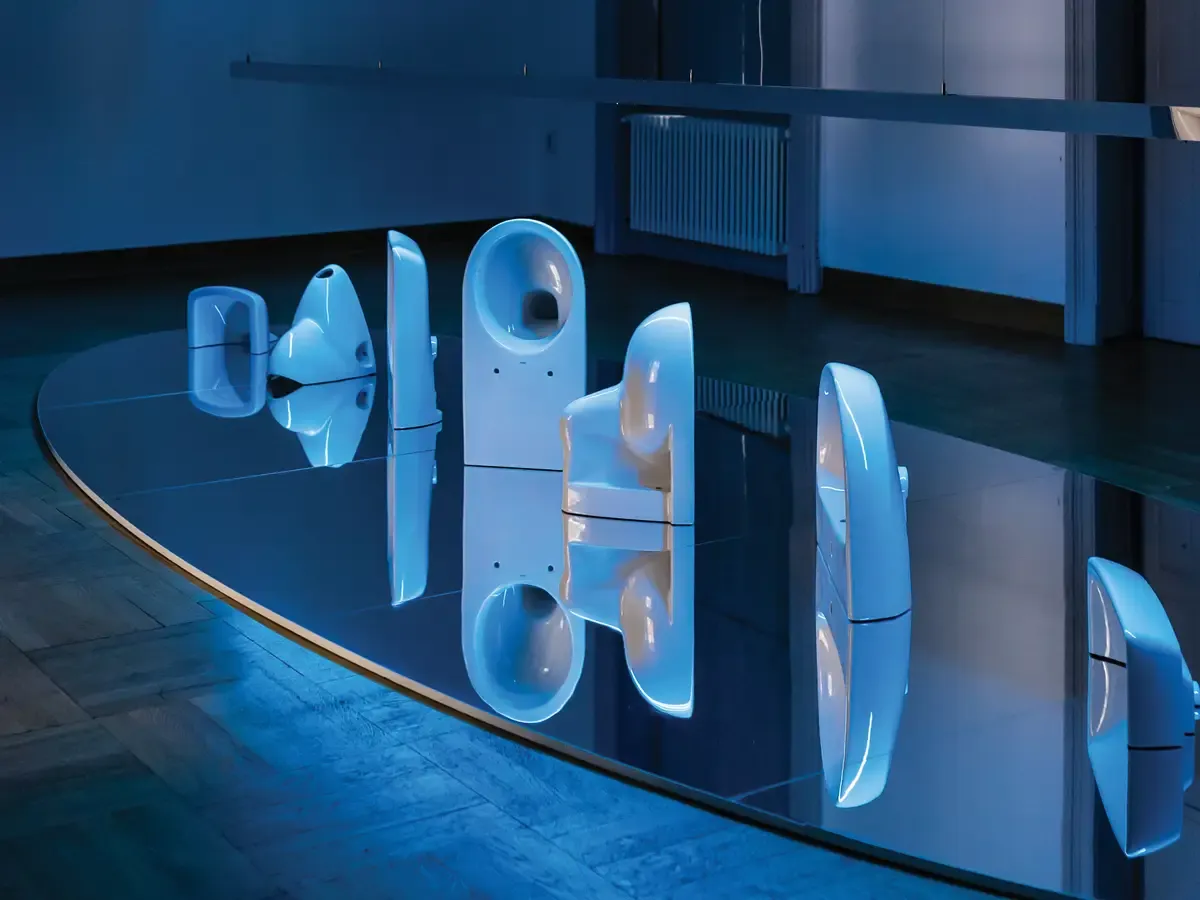
Case study: an eye-catcher can be minimal. Geberit at Design Days 2023
Geberit proved at Design Days 2023 in Katowice that a restrained stand can become an eye-catcher too. Working with hanczar studio, the company realised a purist design that put light at the centre as the key design element. The installation, entirely in blue, presented the product portfolio on a mirrored surface that visually expanded the space and created a calm, inviting atmosphere.
The stand won people over with its clear and open design, which gave visitors orientation and freedom of movement. Reusability was a priority in this design: the stand has a modular design and can be used again in different locations with minimal material and little transport effort. Among other places, the exhibition was used at the conference »Shigeru Ban and Architecture for Refugees« in Warsaw. And yet, or perhaps precisely because of this, it stays in the memory.
Boutique or gated community?
A trade fair stand is like a boutique. In our in-depth interviews, however, we found that exclusivity can also be off-putting, and that is something to avoid. Visitors should be able to find their way around freely without feeling watched. Clear wayfinding helps visitors get their bearings on their own and explore the stand without pressure. At the same time, the stand should offer enough space so that nobody feels they have to squeeze through narrow passages.
Interactive elements can make the first contact easier. Moving installations, such as a robot that presents a product or carries out small demonstrations, draw people’s eyes. Product mock-ups, such as a true-to-scale window profile, also make complex topics »tangible«.
»I find it uncomfortable when there are more staff on a stand than customers.«
Christine Klugassmann gruppe
The number and positioning of the stand team also play an important role, by the way.
Spread the team out evenly instead of letting them stand in groups. Individual team members who stand openly and greet people in a friendly way are more inviting than clusters. And how many staff does a stand need? In our experience, one person per 5 to 15 square metres is enough. The exact number, however, depends heavily on the set-up: small stands, for example at architect@work, should be staffed by two people at most. A 30-square-metre stand can, depending on the topic, also make good use of three to four people.
»Why are there still so many men at trade fairs in the classic blue suit with a red tie? I find that rather off-putting.«
Wiebke AhuesLXSY
How clothing makes an impression
What the stand team wears shapes the first impression. As Wiebke Ahues aptly puts it, traditional trade fair outfits such as suits with a red tie often come across as distant and unapproachable. Female visitors in particular are often put off by overly formal clothing. Instead, clothing should match the brand message and the target group. Do you want to come across as approachable and likeable, or would you rather keep a professional distance? What your stand team wears has a big influence on this. And we don’t mean that everyone has to wear a black polo neck to meet the sweeping design expectations of architects and interior architects. Above all, the team should feel comfortable and come across as approachable.
Conclusion
First impressions decide whether visitors stay at your stand or move on. An open, intuitive stand design feels inviting, while barriers or too many staff in one place put people off. Your team’s clothing and presence also play an important role: approachable outfits and a friendly welcome come across as more likeable than overly formal stand staff. And last but not least: less is often more. Minimalist stands like Geberit’s show that restraint can become the eye-catcher.
You’ll find more insights in our trade fair guide »Messe heute – Messe morgen«.