
From likes to leads
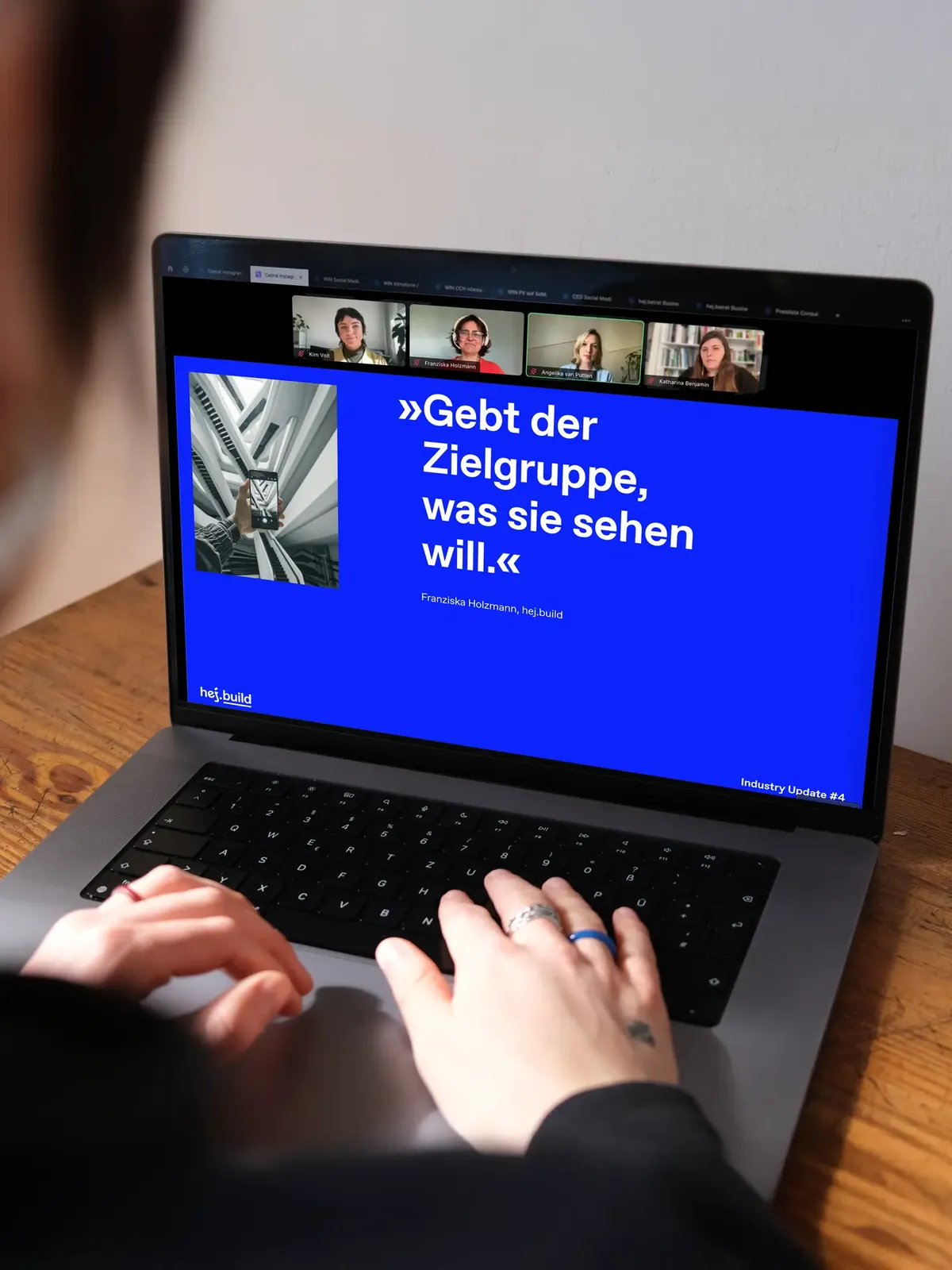
But how do architects and interior architects actually use social media, and what makes them click through or scroll past? That’s exactly what we discussed at the fourth Industry Update, »Schluss mit Wegscroll-Content« (»No more scroll-past content«). Angelika van Putten of STUDIO van PUTTEN gave insights into her everyday work as an interior architect, Katharina Benjamin of kntxtr showed what makes content successful, and Kim Voit, our social media expert at hej.build, translated the findings into strategic recommendations for building product manufacturers.
Inspiration yes, advertising no
Most architects and interior architects don’t use social media as a product catalogue but as a source of ideas and inspiration for references, materials and concrete solutions for their projects. Angelika van Putten describes it from her own experience: »I don’t scroll through social media to actively discover new manufacturers. But if a project or a clever application idea convinces me, I remember the name behind it.«
If you only show products, you’ll quickly be overlooked in the feed.
If you provide real context instead (through reference projects, application examples or a look behind the scenes), you have a much better chance of staying in people’s minds.
Angelika puts it like this: »A picture alone isn’t enough. I want to understand why a solution is special and how it works.«
In short: social media doesn’t just have to look good, it has to be useful. Because the biggest hurdle is the constant battle for attention, with countless manufacturers competing every day to get onto design practices’ radar.
Every social media channel has its own role
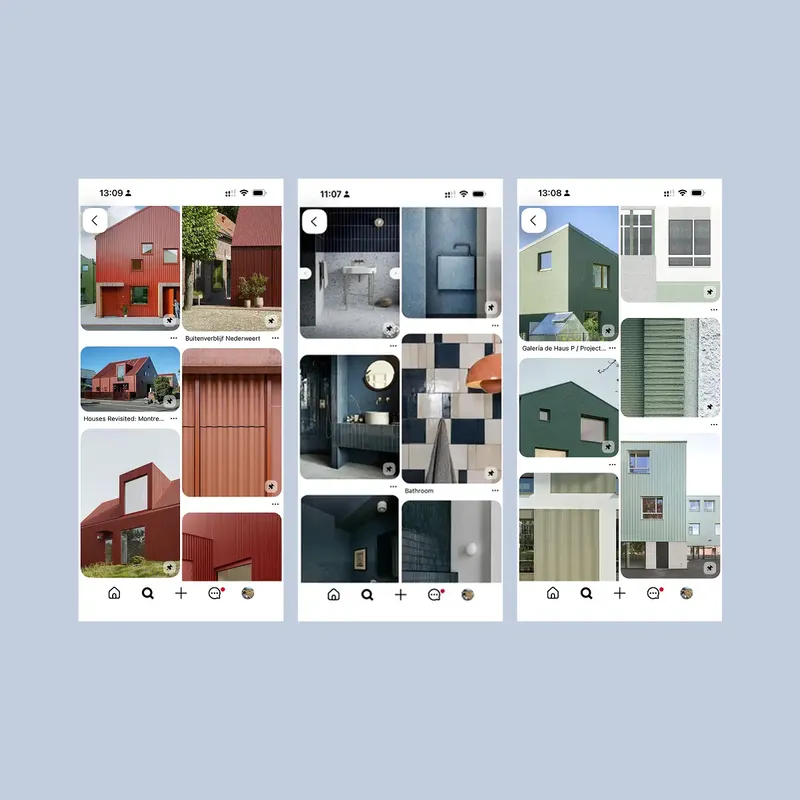
But where exactly do architects get their inspiration? There’s no universal answer. But many use social media very differently depending on the purpose, in their working day (or in the evening on the sofa). Angelika says: »Pinterest is my first port of call for mood boards and material combinations. LinkedIn is more of a digital business card and for event announcements. Instagram is great for quick ideas.«
Social media: pros and cons à la STUDIO van PUTTEN
If social media were a triad, the preferences at STUDIO van PUTTEN would be clearly divided:
- 60% Instagram
- 30% Pinterest
- 10% LinkedIn
Instagram is the central platform where they find information, post themselves, but also win new business and network
Who do they follow? Colleagues, tradespeople, manufacturers, trade press, selected photographers, private individuals with a DIY focus and local businesses.
What gets posted? Project photos, before and after documentation, their own publications and glimpses of events, trade fairs and building sites.
Benefit for manufacturers: Instagram creates visibility, builds trust and allows product tagging. Ideally, products are tagged in an appealing ambience image. That way, architects get straight to the manufacturers.
On Pinterest, the focus is on inspiration and information, beautiful images and materials included
What do people look for? Aesthetically presented inspiration, material information and detail solutions.
What gets posted? Project photos and reference projects with visual details. An important note from the editors: always pay attention to the right copyrights, or it can get expensive.
Benefit for manufacturers: Pinterest isn’t just a platform for inspiration but also a visual means of communication in early project stages. Architects use it to convey first ideas to clients, developers and customers, and sometimes even to sample materials.
»I don’t know a single architect who doesn’t work with Pinterest. At least in the first work stages.«
Angelika van Putten
LinkedIn is mainly for maintaining contacts and saving industry connections
What is it used for? Making and maintaining contacts in the industry.
What gets posted? Only the occasional post. The profile mainly serves as a digital business card with links to the website and other channels.
Challenge: a large number of impersonal requests from unknown companies are seen as annoying and don’t leave an impression of trust.
Benefit for manufacturers: LinkedIn can be a good tool for professional discussions. Here, though, manufacturers should build personal networks rather than just posting product news.
What does this mean for manufacturers?
Angelika van Putten’s use of social media shows: every platform has its own purpose. Manufacturers need to place their content where architects actively look for it, not just where it’s easiest for the marketing team.
From social media consumer to reach expert
Every channel has its own rules of the game. And what works on social media depends heavily on the target group. Katharina Benjamin, founder of Kontextur and an expert in architecture communication, has built one of the most successful architecture communities in the German-speaking world with kntxtr. She understands which content appeals to architects on social media and which manufacturers would do better to avoid.
»On social media, not everything works for everyone.«
Katharina Benjamin
Community instead of one-way communication
A common mistake by manufacturers: social media is used purely as a broadcast channel. But successful architecture accounts work differently. They rely on lively exchange and on building a community. »Our community gives us valuable content: we curate, discuss and make this knowledge usable. If you only broadcast and don’t encourage interaction, you stay invisible.«
What does this mean for manufacturers? Instead of just posting finished product images, they should ask questions, spark discussions or share real reference projects with their challenges and solutions.
Use separate channels and formats for each target group
Every platform has its strengths. And for addressing target groups sensibly, a clear separation pays off: »One big account for everything is often too unspecific. We segment deliberately: our jobs account speaks to job seekers, our events channel concentrates on announcements. That way, every message reaches the right target group.«
Manufacturers should also consider whether it makes sense to address installers and architects on the same channel, or whether a clear separation achieves more.
Watch platform trends, but don’t chase every wave
Social media is constantly changing, and what works well today can be irrelevant tomorrow. »For a long time, Instagram was the measure of all things in the architecture industry. But what if Meta pulls out of the European market? Manufacturers shouldn’t rely on just one platform; they should spread themselves more widely.«
Another takeaway: at the time of the Industry Update, Instagram was once again prioritising carousel posts with informative images over pure reels. So manufacturers can breathe a sigh of relief. Well-prepared visual content stays relevant, and it doesn’t always have to be video.
Authentic collaborations instead of classic advertising
Influencer marketing doesn’t run itself, especially in the architecture industry. »Just get someone to post a product image? That doesn’t work. Successful collaborations happen when the content fits organically into the channel and offers real added value for the community.«
Manufacturers should therefore take the time to find suitable creators who have not just reach but, above all, the right target group. Or, if in doubt, leave it and focus instead on creating their own content or building up corporate influencers.
Three hacks and a best case (as of March 2025)
- Story hack: a single story within 24 hours currently achieves more reach than several stories in a row.
- Be early: new platforms and features often offer more organic reach at the start. So it’s better to be an early adopter and test now, before the market is saturated.
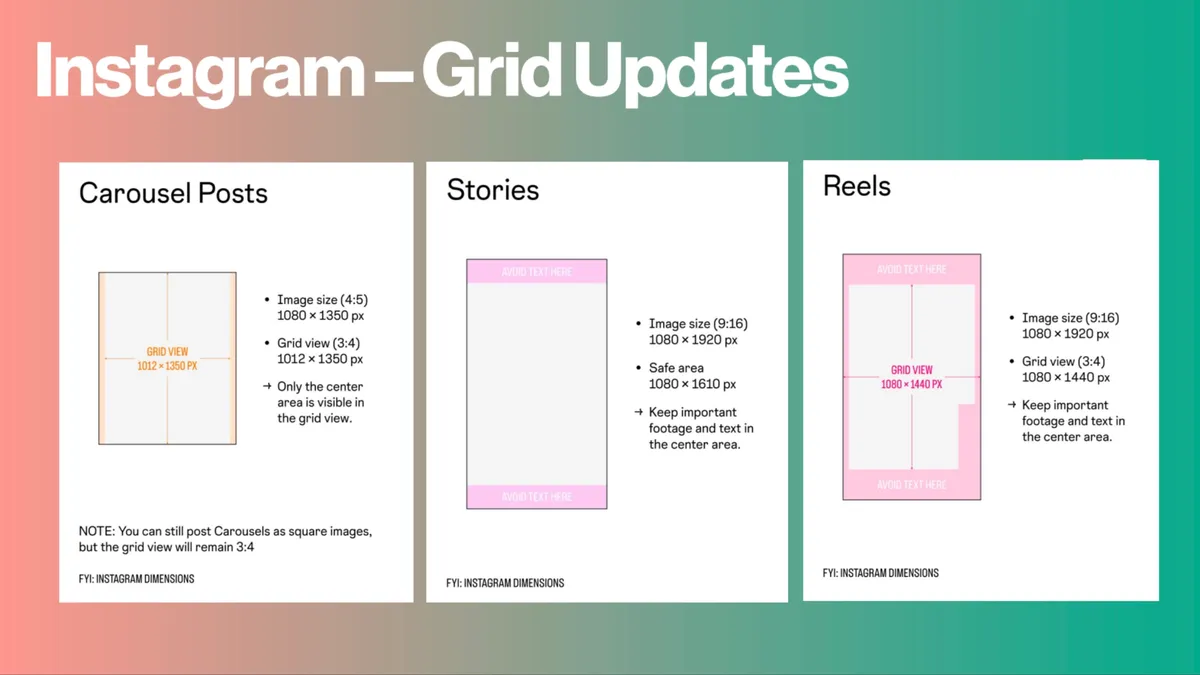
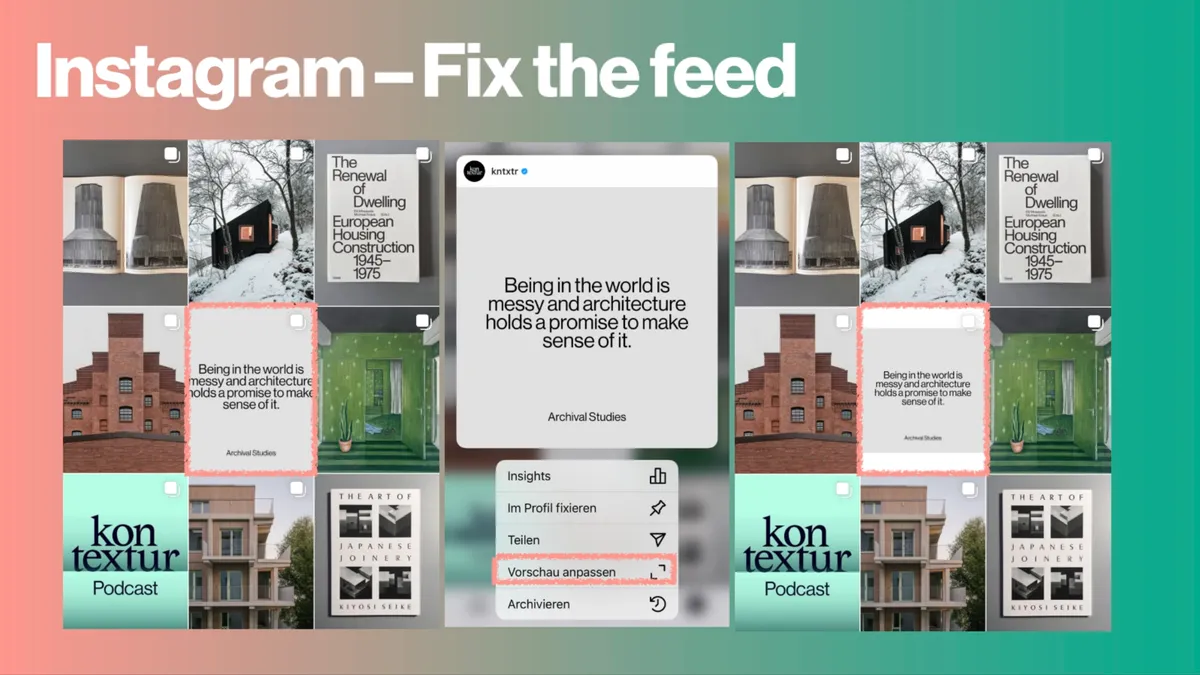
- Instagram grid update: in the feed, posts now appear in portrait format instead of square, and images are cropped differently. If you want a harmonious feed, you should adjust manually.
- Best case: Huguet Mallorca reaches millions with a well-thought-out content strategy. Why? The posts say more than a thousand words.
So how does social media become a real marketing tool for manufacturers?
What makes a successful social media presence in the architecture industry? Which content actually works? And how can manufacturers reach their target groups?
The answer lies in a smart mix of strategic planning, visually appealing design and well-thought-out storytelling.
1. Strategy before posts, or »no plan, no success«
Many manufacturers start without a clear direction and wonder why their content doesn’t perform. But social media needs a foundation:
- Why are you posting?
- Who is the target group?
- Which platforms are relevant?
Important difference: social media isn’t purely a sales channel. Alongside conversions, brand awareness, reach and customer loyalty count. If you don’t define clear goals, you quickly get tangled up in a posting spiral.
2. Technical products need more storytelling than interior products
Not every product is equally easy to market. Interior products are often visually appealing, but building construction products such as cable trays or drainage systems need more context.
Example: an account full of product images achieves little. Manufacturers should show how and where their products are used, which challenges they solve and which architectural qualities they have.
»If social media isn’t working, it’s rarely the cable tray’s fault. It’s the lack of storytelling.«
Kim Voit
3. Define your target group clearly
If you don’t know your target group, you might as well save your marketing budget. Manufacturers need to know exactly who they are addressing and with what content. As a general rule:
- Architects and interior architects are interested in materiality, aesthetics and feel.
- Installers need technical details and application tips.
Tip: one channel for everyone rarely works. It can make sense to address different target groups through separate formats or accounts.
4. Good design doesn’t end with the product
Architects and interior architects have an affinity for design. Manufacturers should be aware that a good visual impression on social media is essential.
What doesn’t work:
- Stock photos with hard hats and staged corporate images
- Standard product photos without architectural context
- Greenwashing images of meadows in bloom
What usually works:
- Professional architecture and material photos
- Reference projects with a clear aesthetic
- Close-ups of textures and materials
5. Reuse existing content several times
Many manufacturers invest in elaborate content but only use it on a single channel. Yet one reference can be used in many ways across different platforms:
- An architecture reference can be prepared as a carousel post for Instagram, a LinkedIn article or a Pinterest mood board.
- Details of this reference can be posted again or turned into a story.
- The same reference again after a year? Why not? Nobody knows a manufacturer’s social media feed by heart.
- A technical article can be broken down into several short social media snippets.
So if you spread and reuse content strategically, you increase visibility without extra production effort.
6. Without ads and media budget, much stays invisible
Organic growth is difficult for manufacturers. Smartly used media budget helps reach the target groups and scale reach.
Example:
- With budget: continuous growth, rising reach and interactions.
- Without budget: stagnation or a decline in visibility.
Tip: the available budget should be used for selected, well-performing content. Especially for well-prepared reference projects and storytelling formats. It doesn’t have to be huge. With €1,000 per month, you can already achieve noticeably more reach.

Feel like getting started?
Both Angelika van Putten and Katharina Benjamin are members of our hej.build Architecture Advisory Board. In our projects on communication in the construction industry, we draw on their target-group-specific expertise from architecture and planning practice when needed. And if you want to use social media, you need not only good content but also a well-thought-out strategy that strikes a chord with the target group.
Every day, we work on the question of how building product manufacturers reach architects, whether through social media, content for design practices or a sophisticated communication strategy. Would you like to talk it through with us?
Then we look forward to a social talk.