
In many building product manufacturers’ strategies, Pinterest still only appears on the sidelines. The platform is often seen as a purely B2C channel or as a nice visual add-on to Instagram and the company website. But our project experience and numerous in-depth interviews, including with the hej.build Architecture Advisory Board, paint a different picture. Pinterest has an early effect. It works where images stick, preferences form and solutions are sorted visually for the first time. In the specification-led project business, this is exactly the moment that counts. In this article, we show what a Pinterest marketing strategy for building product manufacturers can look like.
Why Pinterest is more a search engine than social media
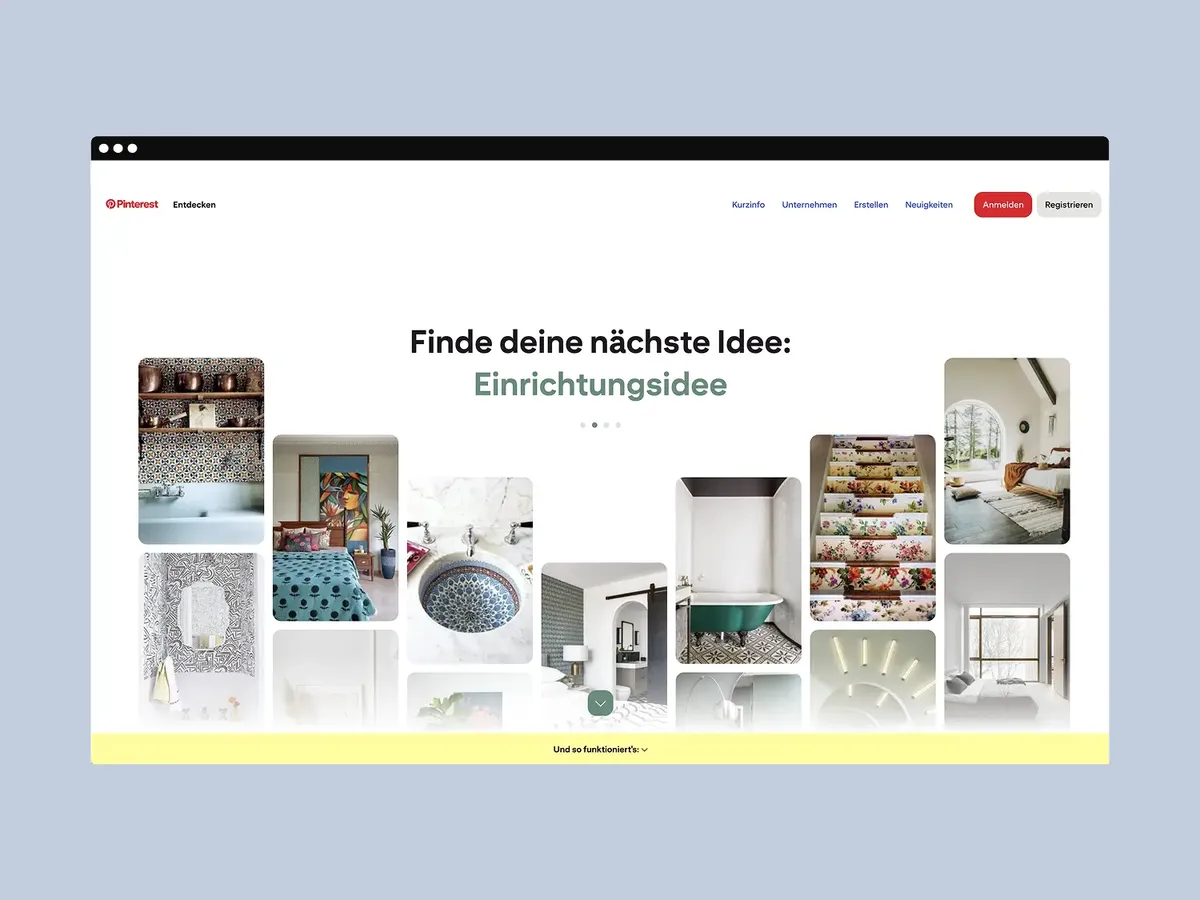
Many marketing teams wrongly lump Pinterest in with the classic social media platforms. Yet Pinterest aptly describes itself as a »visual discovery engine«. Users come to the platform with a clear search intent. They are not primarily looking for brands, but for ideas, atmospheres and spatial principles.
Pinterest is also much less driven by followers than platforms such as Instagram, Facebook or LinkedIn. While the home feed does show content from accounts people follow, relevance for the algorithm comes above all from the topic or keyword context and from specific user signals.
One of the strongest intent signals on Pinterest is the save (keeping a pin on one of your own boards). It is a key lever for organic reach and for the long-term quality of content. A saved pin counts as helpful and stays visible on the board for a long time. Unlike the fleeting interactions of classic social media marketing, a save is not a quick impulse but a sign of work in progress. It says: »I’m keeping this for later.«
»For me, Pinterest is like a big supermarket of ideas.«
Anni Rosenbergwow tomorrow
From an SEO perspective, this means that Pinterest mainly follows a search logic, similar to a search engine like Google. Visibility comes primarily from how well content connects to search queries and from being saved again and again.
For your content to really be seen as relevant in this search process, several cogs have to mesh. In Pinterest marketing, relevance never arises in isolation, only from several factors working together:
- Pin and image (visual quality)
- Title and description (SEO keywords)
- Thematic context (relevance)
- Users’ saving behaviour
Only this interplay decides whether content is passed on or overlooked. Pinterest ads can amplify this logic, but they do not replace it. Paid ads work best on Pinterest when they fit organically into existing search and inspiration patterns (more on this below).
How design professionals use the platform
The fact that Pinterest is mainly used by consumers is no obstacle for building product manufacturers. Quite the opposite. For a good marketing strategy, the key is to recognise that B2B target groups such as the architects and interior architects described here also use the platform intensively as a research tool. Pinterest therefore acts as a central interface where professionals and end customers are active side by side. The focus must therefore be on shaping content to the professional needs of design practices, so that you are present in the early, decisive project stages.
Private individuals and end customers mostly use Pinterest on mobile. They save spontaneously, compare lifestyle inspiration and look for orientation, for example for decisions about their own home. What matters is whether an image conveys a feeling. For this target group, text often plays a minor role.
B2B target groups such as architects and interior architects work differently. They mainly use it on desktop, often through shared office accounts. They save deliberately and with a specific project in mind. Pins serve as a visual database and later feed into mood boards, presentations or internal decision documents. Neutrality is central here.
»We mainly use Pinterest in the early stages of project planning.«
Anni Rosenbergwow tomorrow
Pinterest thus fills the crucial gap between first inspiration and concrete specification: it is the place where architectural visions take visual shape, long before technical details or data sheets come into focus.
Is Pinterest worthwhile for building products?
A question many building product manufacturers ask themselves: is it worth the effort if architects and interior architects don’t search for manufacturers there directly?
The answer is a clear yes, but with the right focus. Pinterest does not replace technical product communication. The platform is relevant where projects begin: in the early HOAI work stages (the work stages defined in Germany’s fee scale for architects and engineers), when images are being collected and a first feeling for space, light and material takes shape.
Architects and interior architects look for atmospheres, proportions and spatial effects. Images help them set a direction before anything technical is fixed. Only in the next step does the assessment begin: why does a room feel calm? Why does it seem open? This early stage is deliberately neutral about manufacturers.
»When we have a specific product in mind, we don’t search for it on Pinterest.«
Laura HeidelaufACMS Architekten
This is precisely where the potential for building product manufacturers lies. Pinterest shapes which images, spatial ideas and design principles make it into the thinking at all. The translation into materials, constructions and systems follows later. That is when the companies that make these effects possible come into focus too. Pinterest rarely decides the final selection, but it strongly influences which solutions are present early on. That makes Pinterest an important part of the marketing mix.
Best practices for content and pins
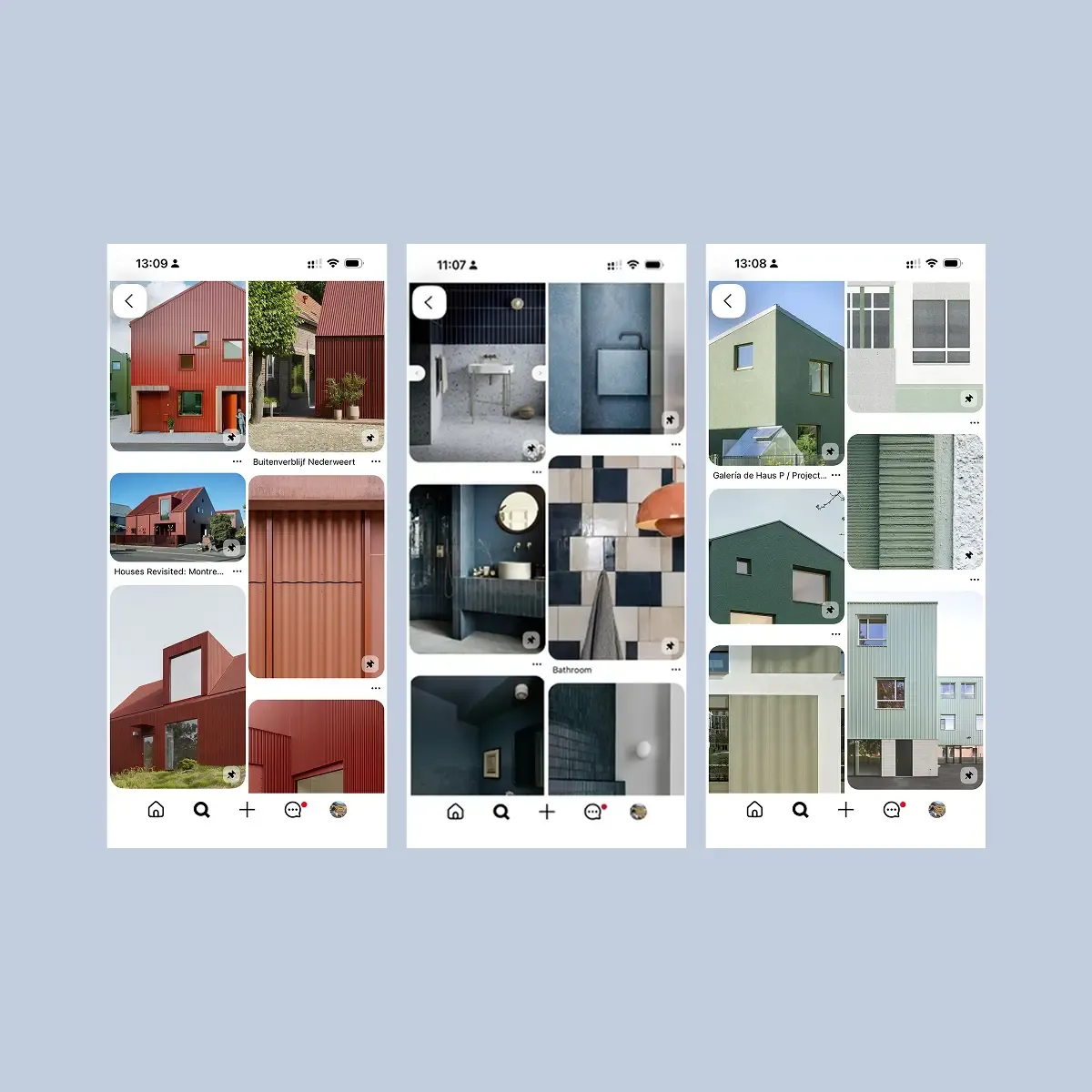
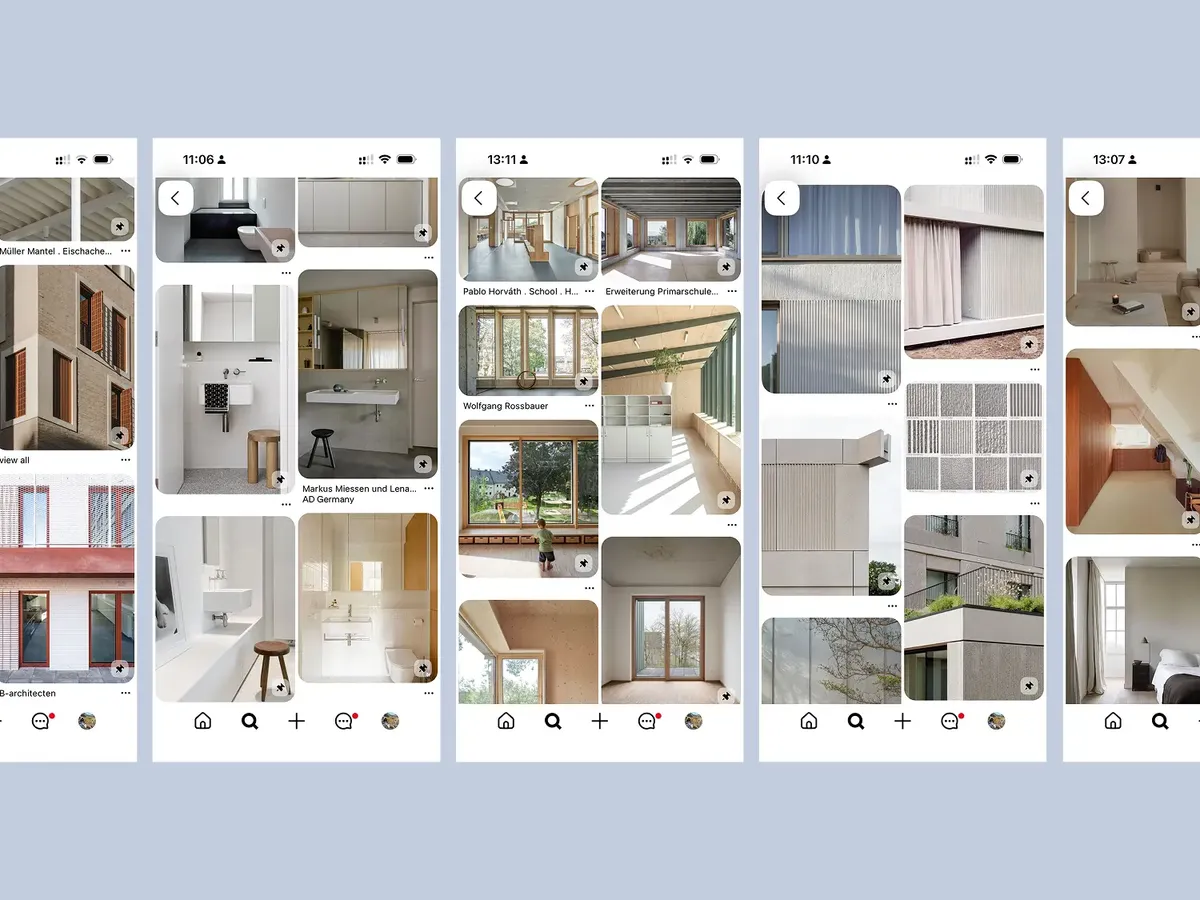
Recurring patterns are emerging in our recent projects. Content is saved more often when it shows products in a spatial context rather than in isolation. Images that make materiality, scale and light tangible generate more saves than plain cut-out product shots.
These are the key success factors for your content:
- Space before product: products work much better when they are part of an architectural situation (with architecture as the context). Architects look for solutions for spatial situations, not for isolated components.
- Visual calm: pared-back imagery without visual overload is saved more often. A clear, aesthetic visual language conveys professionalism and leaves architects room for their own ideas.
- Curation over volume: a precisely curated selection achieves more reach per pin than a large amount of unstructured content. Quality beats quantity: every pin should offer architectural value.
»I need calm when I’m choosing. Advertising or visual clutter ruins that completely.«
Anke Sternankestern interior
These patterns follow directly from the way architects use Pinterest in a professional context.
What Pinterest ads can do in the project business
While the organic strategy forms the foundation, Pinterest ads (Promoted Pins) act as an accelerator. In a B2B context for building products, they are particularly valuable because they appear in the search results not as intrusive advertising but as a fitting solution.
The decisive advantage: ad pins that architects and interior architects save to their project boards remain as organic pins after the paid campaign ends. This long-tail effect ensures lasting reach that extends well beyond the original budget. Ads also allow precise keyword targeting, so you can be present early for competitive terms such as »Fassadengestaltung« (facade design) or »Smart Office Design«.
From SEO to GEO: Pinterest in the age of AI search
Generative answer systems (such as ChatGPT Search or Google AI Overviews) are rapidly gaining importance as search interfaces and often work with linked web sources. At the same time, Generative Engine Optimization (GEO) is establishing itself as an approach for preparing content so that such systems understand it better and cite it as a source more often.
Pinterest is strategically relevant here for two reasons:
- As a platform in its own right: Pinterest relies heavily on context (image + title + description + thematic boards) and on user signals such as saves. This makes content easy for algorithms to read.
- As an AI ecosystem: Pinterest trains its own GenAI systems, such as »Pinterest Canvas«, on pins, descriptions and metadata that users upload to or save on the platform.
Maintaining pins today with precise descriptions, a clear board structure and Rich Pin metadata mainly increases findability within Pinterest, and at the same time improves the chance that content appears as a citable web source in AI-powered search interfaces.
Which metrics count?
Building product manufacturers often make the mistake of comparing Pinterest with the KPIs of Instagram or other classic social media platforms. To assess the success of your marketing strategy, focus on these signals in Pinterest Analytics:
- Saves (save rate): one of the strongest intent signals. It shows that your product has become part of a mood board or a design process.
- Visibility in the discovery context: analyse impressions and saves by source (search vs. home feed etc.) as well as keyword clusters via Pinterest Trends. This shows you how deeply you are reaching into thematic searches such as »Fassadengestaltung« or »moderne Badplanung« (modern bathroom design).
- Outbound clicks: how many users move from inspiration to a closer look on your website? Note: as soon as users reach your site, classic web analytics take over the tracking. Here you should also look at metrics such as time on page and conversion rate (for example CAD downloads, sample orders or contact enquiries) to make a final assessment of the quality of your Pinterest traffic.

Five steps to a professional Pinterest presence
- Set up a business account: use a verified profile and install the Pinterest tag for precise tracking.
- Keyword research: identify which terms architects and interior architects actually search for in the early stages.
- Aesthetics check: invest in professional architectural photography. Pinterest is a purely visual place: image quality decides whether a pin gets saved.
- Board structure: create boards by area of application (for example »Hospitality Design«) rather than just by product category.
- Consistency: Pinterest rewards regular activity. Plan your content ahead instead of uploading everything at once.
Curious what role Pinterest could play for your company?
Pinterest is not a direct sales channel. Pinterest is an early indicator of relevance in B2B and B2C contexts, and that is why it belongs in building product manufacturers’ marketing strategy.
For building product manufacturers, the lever lies in understanding the early search and design stages. Treating Pinterest like just another social media channel misses the logic of the platform. Understanding Pinterest as a visual search engine puts you where projects begin.
At hej.build, these early stages are exactly what we work on: in interviews, analyses and current projects with building product manufacturers.
We’d be glad to talk about the potential Pinterest could have for your brand.