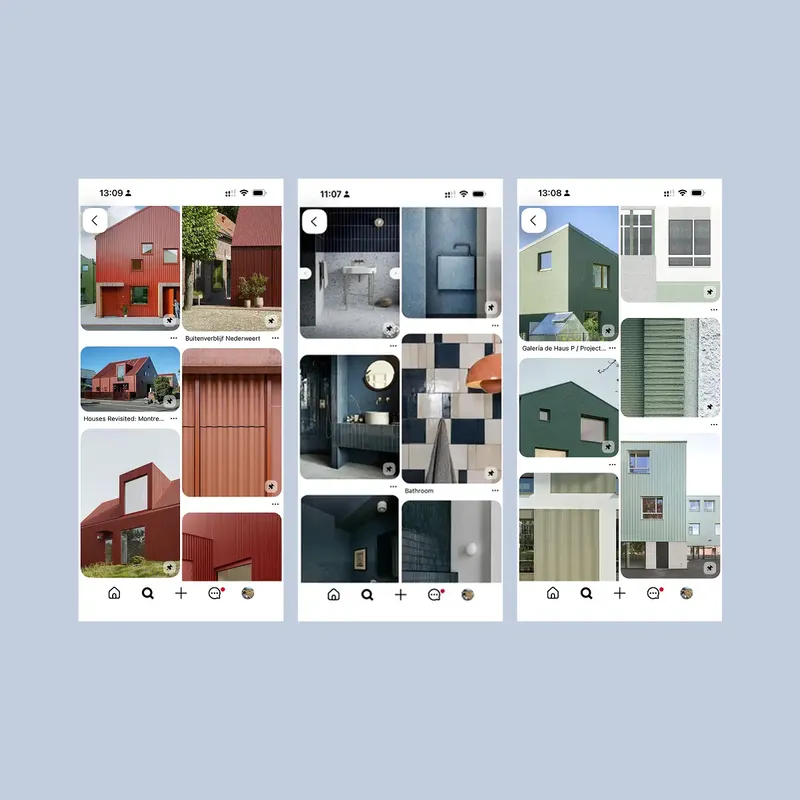
Picture an architect who is back at her desk after BAU. On her smartphone: photos of materials, constructions and product names. In her inbox: the first messages from the fair. At the next desk, a colleague asks whether she found anything for their joint project.
What can she tell him about your stand? What can she show him? And will she find the information again that sounded so interesting in the conversation?
This small scene is a good starting point for the rest of your preparation for the fair. The stand is booked, the new products are fixed, the stand build is taking shape. Now you can make sure that a visit to you keeps having an effect in the day-to-day work of design practices.
For our trade fair guide »Messe heute – Messe morgen« (Trade fairs today, trade fairs tomorrow), we surveyed planners and manufacturers. For Messe München, we then developed the report »100 Messe-Tipps« (100 trade fair tips). The conversations show how much depends on apparent details: a precise invitation, an accessible sample, a person who listens and actually delivers an answer they promised.
Your invitation has to trigger something at the practice
»See you at BAU« is a friendly message. For planning a visit, though, it leaves quite a lot open. Who should come to see you? What is there to discover? Is it worth bringing along a colleague from technical design?
For our trade fair guide, we asked 126 people from architecture and planning about their experiences at trade fairs. 76 of them visit trade fairs regularly. Around two thirds of these regular visitors decide in advance which stands or talks they want to visit. A small sample, but a good reason to take your own invitation seriously.
To do this, go through the practices you want to reach with your sales team. Look at who is currently working on existing buildings or facing a material decision. Also think of practices you have not been in touch with for a while and for whom your new solution could be of technical interest.
This leads to different invitations. One practice wants to understand a junction in detail, another wants to compare surfaces. Describe what you offer so specifically that the message can be forwarded internally: this could be interesting for your project.
Wiebke Ahues, partner at LXSY Architektur, puts a clear wish into words in the report:
»As an architect, I would like a building product manufacturer to send me a personal invitation four to six weeks before the fair.«
Wiebke Ahues, LXSY Architektur
For BAU 2027, this window falls in December. Plan around Christmas and the turn of the year: prepare content and contact people in November and send your personal invitations in early December if you can. In January, you can remind people of agreed appointments and give some final practical information.
Turn your trade fair topic into a design question
BAU 2027 has four key themes: »Material and resources«, »Climate protection and climate adaptation«, »Changing Living Space« and »Digitalization and productivity«. Many manufacturers will find themselves somewhere in these. It gets interesting where you link them to a specific task.
How can a component be taken apart again later? What build-up height does a solution need in a refurbishment? Which information helps to assess a material? Which work steps does a system make easier?
Choose a question that you can answer soundly with your building products. It gives your communication a focus and your stand team a reason to start a conversation. At the same time, it helps you decide what you still need to prepare: perhaps a sectional model, a sequence of images that is easy to follow or a completed project with a revealing detail.
Our stand concept for Ardex at the Heinze Klimafestival 2025 included a take-back station. That gave the topic a concrete place where people could engage with it. The communication plan ran from pre-event communication to follow-up.
For your stand, which is already planned, you can ask the same question: which exhibit can take on such a task? Often it mainly needs a better explanation, an accessible position and someone who can answer the right questions.
Let people discover something
Anyone who touches a surface or tries out a connection is already engaging with your product. Give that moment room.
In our survey, more than nine in ten regular trade fair visitors rated hands-on experiences and product samples as important or very important.
So take another look at your presentation: can people take the samples out? Can variants be laid side by side? Can visitors tell what they are holding? Can someone photograph a detail and still identify the manufacturer and product later?
Add information to the exhibits that is easy to find without searching. A QR code should lead straight to whatever is of interest for that product: technical documents, a reference project, available versions or a sample order. For every link, think about what someone can do with it at their desk.
And let visitors look around undisturbed sometimes. A planner who does not want a conversation right now can still be very interested.
For OBO Bettermann, we developed a stand concept on 120 square metres for BAU 2025 with few presentation surfaces and open areas for conversation. This deliberate layout makes room for different ways of approaching a product. You can look at your own stand plan in exactly the same way: where can people discover, where can they ask, where can they think something through together?
Prepare your team for real conversations
A trade fair briefing covers products, rotas and organisational details. Also take time for the situations that fall between these points.
A visitor asks about an application you have never delivered. Someone wants to know what evidence is available. Another person only has a few minutes and is looking for a specific piece of technical information.
Run through conversations like these in advance and clarify who can answer or go deeper into which technical questions. Also agree how you will record open questions and pass them on to the person responsible.
For OBO Bettermann, we supported the preparation with a five-hour remote training session for 14 people from the trade fair and sales teams. A session like this gives you room to try out answers and to clear up uncertainties before the fair.
Practise listening in particular. A simple question such as »What are you working on at the moment?« can open a conversation. The answer should then also shape what you show.
Good preparation also means being able to name your limits. If a piece of evidence is missing or an application still needs to be checked, say so openly. Note who is taking care of it and when an answer is possible.
The first follow-up can happen on Tuesday
BAU lasts five days. Your visitors may well be back at their offices while you are still on the stand.
That is why a fixed link to your colleagues back at base is worth it. Who sends samples? Who answers technical questions? Who can arrange an appointment with the right technical advisor? Reserve this capacity before the fair.
Two questions help in the conversation: what do you need next? And by when?
The answers belong in your contact note, together with the project context. »Interested in facade products« will not help much later. A note on the application, the stage of the design, the open question and the agreed next step makes the contact something you can work with.
Not every conversation needs to trigger a personal follow-up email. Some visitors want to do their own research. Others are waiting for exactly the detail you promised. Chris Middleton of Kinzo describes it like this in our trade fair guide:
»I personally ignore automated emails completely. Personalised follow-up, however, can be very useful.«
Chris Middleton, Kinzo
So prepare your website for the fair just as carefully as your inbox. The products on show should be easy to find, documents accessible and contact people clear. That way, colleagues at the design practice who were not in Munich themselves can keep working too.
Set aside time for afterwards now
Before BAU, decide when marketing and sales will go through the conversations together. Straight after the fair, you can sort out open promises and responsibilities. With a little distance, you can look at which contacts are developing.
Take a closer look: did samples end up in a specific material selection? Was there a technical consultation? Did a practice invite you to present a solution to its team? Which projects will need attention again later?
Also collect the questions your team had no good answer to. Recurring questions can point to missing documents, unclear product communication or a need you have underestimated so far.
In the remaining weeks, you can create specific reasons to visit for your most important topics. At the same time, clarify who will give technical advice at the stand and follow through on the promises made in conversations.
When the architect is back at her desk after Munich, she should have brought something useful with her. A sample she can show. A detail that moves her design forward. A contact she is happy to call again.
The whole hej.build team will be at BAU 2027 in Munich. If you are working on these connections between communication, trade fair presence and sales right now, we would be glad to talk to you about it.